
FRW 1 Billion in Annual Turnover? What Rwandan Businesses Need to Know
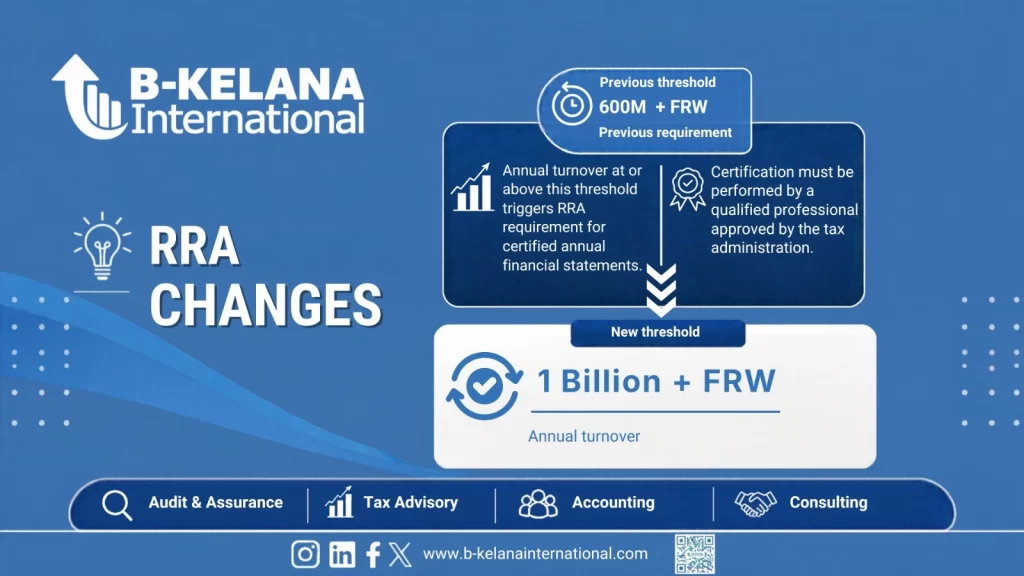
A practical guide to Rwanda’s updated financial statement certification rules
Is your business approaching FRW 1 billion in annual turnover? If so, it is time to review your accounting records and understand whether your annual financial statements must be certified. Rwanda’s Ministerial Order Nº 009/26/10/TC of 24/09/2026 Determining the person’s Permanent Residence, Location of Effective Place of Management and Annual Turnover required for Certification of Financial Statements sets out the annual-turnover threshold, identifies certain exceptions and explains who may certify financial statements.
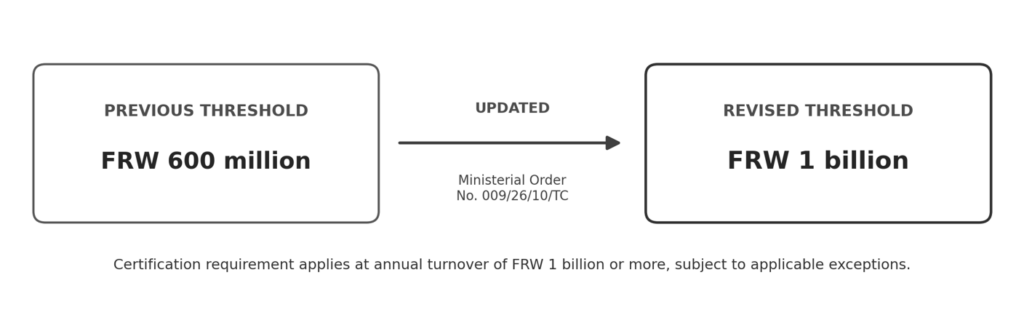
The key change: A FRW 1 billion threshold
Article 3(1) of Ministerial Order Nº 009/26/10/TC provides that a taxpayer whose annual turnover is equal to or greater than FRW 1,000,000,000 must have their annual financial statements certified by a qualified professional approved by the tax administration. The Order was published in the Official Gazette n° Special of 25/09/2026 and entered into force on the date of publication.
For businesses, the practical first step is straightforward: calculate annual turnover using reliable accounting records, compare it with the FRW 1 billion threshold and confirm the certification requirement that applies to your circumstances.
Important: The Order names specific exceptions
The Order provides an exception to the certification obligation in Article 3(1) for certain taxpayers operating as authorized distributors of beer, lemonades, soda, juice or cement; dealers in petrol or petroleum products; owners of forex bureaus; air-ticket dealers; tour operators; farming or livestock cooperatives; and independent agents. These taxpayers are not bound by that obligation unless the income they earn exceeds the required annual-turnover threshold.
Do not assume that an exception applies simply because your business operates in a related sector. Check the precise wording and conditions of the Order, and seek clarification from the Rwanda Revenue Authority (RRA) or a qualified tax professional if your status is uncertain.
Turnover is the measure specified by the Order
Article 3 refers to annual turnover. It does not set out a separate certification trigger based on gross margin. Turnover and gross profit are different measures: turnover generally refers to revenue from business activity, while gross profit is what remains after deducting the direct cost of goods sold. Businesses should therefore avoid substituting a gross-margin figure for the turnover test in the Order.
Who is allowed to certify the statements?
The Order requires certification by a qualified professional approved by the tax administration. Article 3(3) states that the Head of the tax administration determines the modalities for approving these professionals. Before engaging an accountant or firm, businesses should verify that the professional is appropriately qualified and approved for this purpose.
The Order requires annual financial statements to be certified by a qualified professional approved by the tax administration. Under Article 3(3), the Head of the tax administration determines the modalities for approving these professionals.
Qualified practitioners who meet the applicable requirements are permitted to certify financial statements in accordance with the Ministerial Order.
Businesses should therefore verify the qualifications and approval status of the individual practitioner they intend to engage before proceeding with certification. Similarly, audit and accounting firms should review the applicable approval requirements to ensure that their practitioners are authorized to provide these services under the relevant legal framework.
The Order also addresses residence and effective management
Beyond the turnover threshold, the Order deals with a person’s permanent residence and the location of an entity’s effective place of management. For an individual, a home, apartment, hotel or other residential accommodation in Rwanda where the person usually stays may be treated as their permanent residence.
For an entity, the Order says its effective place of management is in Rwanda if at least one of the listed conditions is met: day-to-day control or management takes place in Rwanda; shareholders’ meetings are held in Rwanda; its books of account are kept in Rwanda; or its main shareholders or directors are residents of Rwanda. Businesses with cross-border operations should consider these criteria carefully and obtain professional advice where necessary.
A practical checklist for businesses
- Calculate and document annual turnover using complete, up-to-date accounting records.
- Check whether annual turnover is equal to or greater than FRW 1 billion.
- If your business falls within one of the categories listed in Article 3(2), verify whether the exception applies to your specific circumstances.
- Prepare annual financial statements early rather than waiting until a filing deadline is close.
- Confirm that the professional you appoint is qualified and approved by the tax administration.
- If your business has cross-border operations, review the Order’s permanent-residence and effective-management provisions where relevant.
- Ask the RRA or a qualified tax professional about any uncertainty in interpretation or application.
Conclusion
Ministerial Order Nº 009/26/10/TC makes the FRW 1 billion annual-turnover threshold central to the financial statement certification requirement, while providing specified exceptions and requiring certification by an approved qualified professional where the obligation applies. The right response is not to wait until year-end: review your turnover, understand whether an exception may apply, keep your records in order and confirm your position with the RRA or a qualified adviser.
Better Transparency. Stronger Compliance.
© 2026 B-KELANA International (R) Ltd
Committed to Professional Excellence
Empowering Growth. Fostering Integrity. Delivering Excellence.